

By Information Giants Reporter
Remember when social media was going to change how companies talk to us? The promise was conversation. Brands would stop shouting from billboards and start listening, replying and being changed by what they heard. A new study by Moses Moreroa suggests that, on one of the world’s most popular apps, that promise is quietly being reversed.
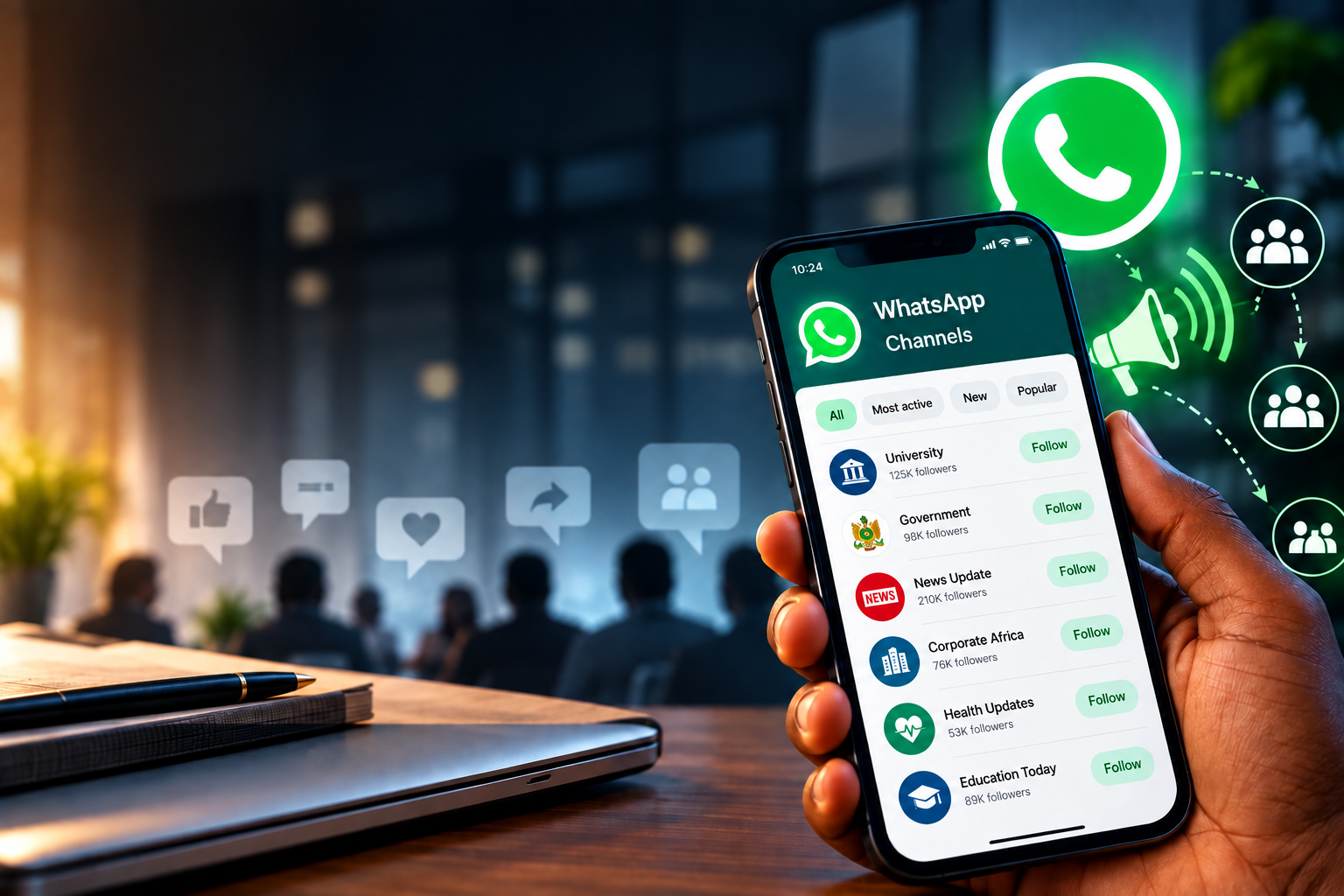
The culprit is WhatsApp Channels. Launched globally by Meta in September 2023, Channels let an organisation send updates to an unlimited number of followers. Those followers can tap an emoji or answer a poll. They cannot reply, comment, or even see who else is following. It is, communication researcher Moses Mashwahla Moreroa argues, a megaphone installed inside a messaging app built for whispering.
He has a name for it: re-broadcastification. The term describes what happens when a platform known for two-way talk is redesigned, on purpose, so organisations can speak without ever having to listen. It is not simply old-fashioned broadcasting, because radio and television never had an intimate, conversational past to abandon. What makes WhatsApp different is the contrast. Next door to your family group chat, the same app now hosts a one-way announcement board.
The twist is that companies wanted this long before Meta built it. Moreroa’s review of the research finds a striking pattern across three continents. Government offices in Tanzania, municipalities in Spain and corporate communicators in South Africa were all handed a fully interactive tool, and all mostly used it to push messages out. South African practitioners talked about social media in terms of controlling the agenda, not starting a dialogue. Channels, in other words, did not invent the habit. They made it permanent by removing the option to do anything else.
The contrast with what WhatsApp can do is stark. In one Nigerian professional association’s group chat, nearly two-thirds of messages were genuinely interactive. On a Channel, that kind of exchange is technically impossible. An emoji is the ceiling.
So are Channels just digital billboards? Not quite, Moreroa concludes. A billboard is paid-for space you drive past; a Channel is free, opt-in and lands on your phone. But they share the same basic logic: one voice speaking, an audience receiving, no way to answer back. And in mobile-first markets like South Africa, the study raises an uncomfortable possibility. If organisations broadcast for free, the cost of receiving all that content may shift onto followers paying for their own data.
This is not a simple takedown. The paper credits Channels with real advantages: no moderation headaches, reliable reach as Facebook and X referrals decline, and clean, single-source messaging in a crisis. Publishers such as the Financial Times and the New York Times jumped on board within weeks. The advice for organisations is to use Channels for announcements, but not to mistake follower counts for genuine engagement.
Perhaps the most surprising finding is a gap. Moreroa found no peer-reviewed study examining Channels from a corporate communication angle. His argument is therefore a well-grounded proposition rather than a settled fact. Still, it delivers a sharp reminder: “social” is a design choice, and platforms can switch it off.
Moreroa, M. M.(2026). When Social Media Stops Being Social: WhatsApp Channels and the Re-Broadcastification of Corporate Communication. Advances in Journalism and Communication, 14, 238-261.https://doi.org/10.4236/ajc.2026.143012